Cleanroom-Safe, FDA-Compliant Equipment Cleaning
Pharmaceutical manufacturing demands extreme precision, strict sanitation, and regulatory compliance at every stage of production. From tablet presses and capsule machines to cleanrooms and packaging lines, contamination risks and equipment downtime can lead to costly production delays, compliance violations, and compromised product integrity.
Dry ice blasting has emerged as one of the most effective cleaning technologies in pharmaceutical manufacturing, offering a residue-free, non-abrasive, and FDA-friendly cleaning solution that protects sensitive equipment while maintaining strict sanitation standards. Unlike traditional chemical cleaning or water-based methods, dry ice blasting uses solid carbon dioxide (CO₂) pellets to remove contaminants without leaving secondary waste or moisture behind.
This guide explores how dry ice blasting works in pharmaceutical facilities, key applications, compliance benefits, and why manufacturers are rapidly adopting this technology to improve operational efficiency and regulatory performance.
What Is Dry Ice Blasting?
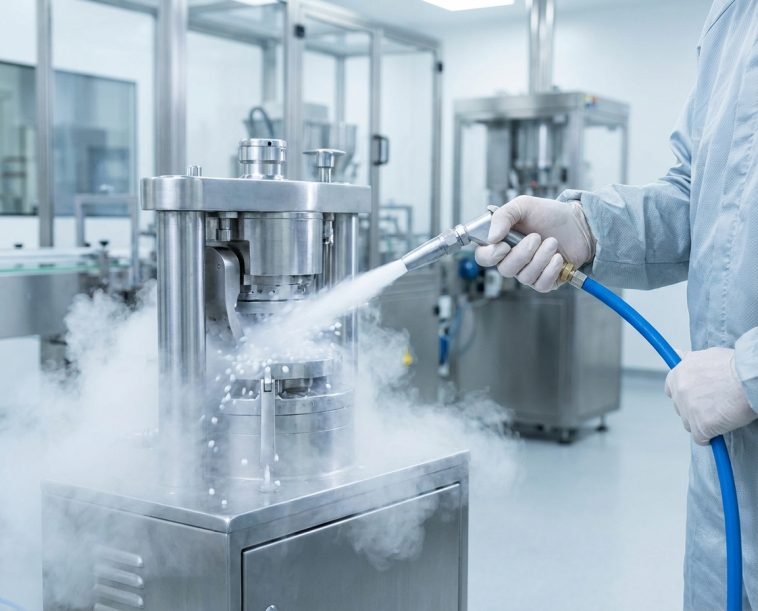
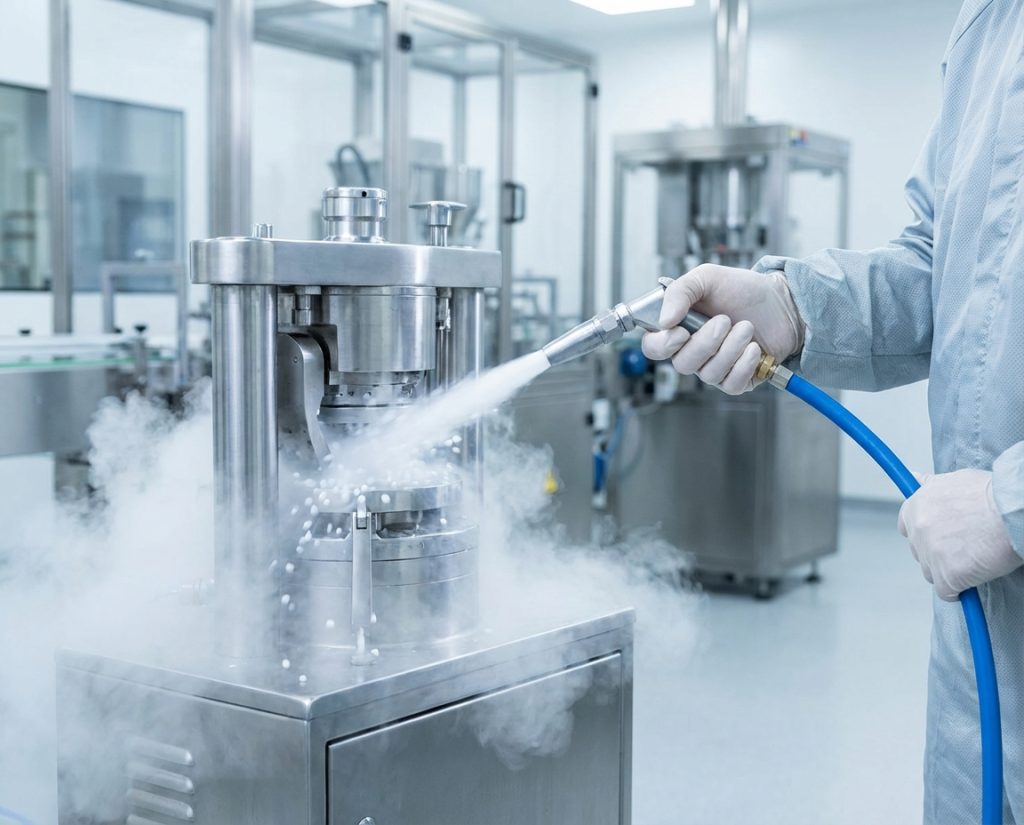
Dry ice blasting is an industrial cleaning method that uses compressed air to accelerate dry ice pellets at high velocity, removing contaminants through a combination of kinetic energy, thermal shock, and sublimation. When the pellets strike a surface, they instantly convert from solid to gas, lifting contaminants away without damaging the underlying material.
Key Characteristics
- Non-abrasive and safe for sensitive equipment
- No water or chemicals required
- No secondary waste or residue
- Clean-in-place capability
- Environmentally friendly
- Minimal equipment downtime
This makes dry ice blasting particularly valuable in pharmaceutical manufacturing environments where cleanliness, precision, and compliance are critical.
Why Pharmaceutical Manufacturers Use Dry Ice Blasting
Pharmaceutical production facilities must meet strict FDA, GMP, and cleanroom standards while maintaining efficient operations. Traditional cleaning methods such as solvents, pressure washing, or manual scrubbing often introduce moisture, chemicals, or abrasion that can damage equipment or require lengthy validation processes.
Dry ice blasting eliminates these challenges by providing a dry, residue-free cleaning process that simplifies compliance and improves productivity.
Core Benefits
1. Residue-Free Cleaning for Cleanroom Environments
Dry ice sublimates into gas, leaving no liquid or blasting media behind. This reduces contamination risks and simplifies validation procedures in pharmaceutical environments.
Facilities benefit from:
- Reduced cleaning verification time
- No chemical residue testing
- Cleaner production lines
- Improved batch changeover efficiency
Dry ice blasting is especially valuable in cleanrooms and sterile production areas, where even microscopic contamination can affect product quality.
2. FDA and Regulatory Compliance
Regulatory agencies require pharmaceutical manufacturers to ensure that cleaning methods do not introduce contaminants or hazardous chemicals.
Dry ice blasting supports compliance by:
- Eliminating chemical cleaning agents
- Reducing hazardous waste documentation
- Simplifying audit and inspection processes
- Improving sanitation validation
Facilities using dry ice blasting often experience smoother regulatory audits due to standardized and repeatable cleaning processes.
3. Reduced Equipment Downtime
One of the biggest advantages of dry ice blasting is clean-in-place capability.
Equipment can be cleaned:
- Without disassembly
- Without cooling down
- Without extended shutdowns
- During scheduled maintenance windows
This significantly reduces production downtime and improves operational efficiency.
Manufacturers benefit from:
- Faster cleaning cycles
- Increased equipment uptime
- Lower maintenance costs
- Improved production scheduling
4. Safe for Sensitive Pharmaceutical Equipment
Pharmaceutical machinery often includes:
- Stainless steel surfaces
- Rubber seals
- Electronics
- Injection molds
- Tablet presses
- Conveyors
Dry ice blasting is non-abrasive and non-conductive, making it safe for delicate components and expensive equipment.
This reduces:
- Tooling replacement costs
- Equipment wear
- Maintenance expenses
- Risk of damage during cleaning
Dry ice blasting also helps preserve molds and production tools, extending equipment lifespan and improving product quality.
Common Dry Ice Blasting Applications in Pharmaceutical Manufacturing
Tablet and Capsule Production Equipment
Dry ice blasting removes:
- Powder buildup
- Residue
- Lubricants
- Adhesives
- Contaminants
from:
- Tablet presses
- Capsule filling machines
- Coating systems
- Conveyors
This ensures clean equipment between production runs and reduces cross-contamination risk.
Injection Molds and Rubber Components
Pharmaceutical molds often accumulate:
- Release agents
- Polymer buildup
- Residue
- Dust and particles
Dry ice blasting cleans molds without altering geometry, helping maintain precision and reduce scrap rates.
Cleanrooms and Controlled Environments
Dry ice blasting is used in:
- Cleanroom walls and floors
- Stainless steel surfaces
- HVAC components
- Production lines
- Packaging areas
Because it produces no water or chemicals, it supports strict cleanroom standards.
Conveyor and Packaging Equipment
Dry ice blasting removes:
- Dust
- Adhesives
- Ink
- Residue
- Product buildup
This improves:
- Product safety
- Equipment reliability
- Operational efficiency
Environmental and Safety Advantages
No Chemical Exposure
Traditional cleaning methods require:
- Solvents
- Detergents
- Degreasers
- Water treatment
Dry ice blasting eliminates these, reducing worker exposure and improving workplace safety.
Facilities benefit from:
- Reduced PPE requirements
- Lower chemical storage risks
- Simplified safety protocols
- Improved OSHA compliance
Eco-Friendly Cleaning Solution
Dry ice blasting supports sustainability by:
- Eliminating chemical waste
- Reducing water usage
- Producing no secondary blasting media
- Supporting cleaner production processes
Research shows dry ice blasting contributes to cleaner industrial production by minimizing environmental impact and chemical usage.
Dry Ice Blasting vs Traditional Pharmaceutical Cleaning Methods
| Cleaning Method | Water Use | Chemicals | Residue | Equipment Risk | Downtime |
| Chemical Cleaning | High | Yes | Yes | Moderate | High |
| Pressure Washing | High | Sometimes | Yes | Moderate | High |
| Sandblasting | No | No | Yes | High | Moderate |
| Manual Cleaning | Low | Yes | Yes | Low | High |
| Dry Ice Blasting | None | None | None | Low | Minimal |
Dry ice blasting stands out as the most efficient and compliant cleaning method for pharmaceutical environments.
How Dry Ice Blasting Improves Pharmaceutical Production Efficiency
Faster Changeovers
- Reduced cleaning time
- Faster batch transitions
- Increased production output
Lower Maintenance Costs
- Less equipment wear
- Reduced downtime
- Longer equipment lifespan
Improved Product Quality
- Cleaner equipment
- Reduced contamination
- Consistent manufacturing conditions
These advantages make dry ice blasting a strategic investment for pharmaceutical manufacturers focused on quality and compliance.
The Future of Dry Ice Blasting in Pharmaceutical Manufacturing
As pharmaceutical manufacturing becomes more regulated and automated, dry ice blasting is expected to play an even larger role in:
- Cleanroom automation
- Contamination control
- Sustainable manufacturing
- Predictive maintenance
- Regulatory compliance systems
The technology aligns with industry trends focused on efficiency, safety, and environmental responsibility, making it a long-term solution for pharmaceutical production facilities.
Conclusion
Dry ice blasting is transforming pharmaceutical manufacturing by providing a non-abrasive, chemical-free cleaning solution that supports sterile environments and regulatory compliance. The technology removes contaminants without leaving residue or moisture, helping maintain cleanrooms, protect sensitive equipment, and reduce production downtime—critical factors in pharmaceutical operations where precision and hygiene are essential.
To see how this innovative cleaning method can improve efficiency and compliance in your facility, explore nexAir’s dry ice blasting solutions for pharmaceutical manufacturing and discover industry-ready applications and expert support: https://www.nexair.com/dry-ice/pharmaceutical-manufacturing/